If you spot a lion sculpture in the back of a white pickup driving on the interstate east bound the lions name is Mufasa and the artists name is John Lopez.
This life-size bull elk will be installed permanently at Mountain View Cemetery in Rapid City, SD.
Telling the story of life on the prairie is incomplete without the bison, the main resource of generations of Native peoples who called this region their home. The Grand River once knew vast herds of bison, unconfined by fences, as it now knows cattle and sheep that are moved from pasture to pasture by ranchers on horseback.
To do this majestic creature justice, I again began with a clay model that would be cast into bronze. With calipers, I measured angles in inches that were translated into feet. Then, I sorted through Geno’s oil well pipe for the sturdy legs and framework. It was the same pipe Geno had bought by the truckload for corral construction, and that I had used on Effie’s gate. Thankfully, he had a lot left over.
It had become kind of a puzzle to see how many bronze castings I could fit into a design; for this one I used nearly two-dozen, from wildlife to Mount Rushmore. I also incorporated an abstract bald eagle—an indigenous resident of The Grand—with its wing sweeping back along the right side of the bison’s hump.
Dakotah represented an important turning point in my discovery of this new body of work. While envisioning the multitude of possibilities and experimenting in the shop, I had fantastic Technicolor dreams that fueled my twilight hours. An exciting, artistic adrenaline high carried me through workdays that stampeded into weeks, months, and eventually resulted in one ton’s worth of draped chains, curls of sheet metal, sickle guards, and hunks of cable-wire “hair.”
George Burns lives north of Morristown, South Dakota. George had one of the largest collections of John Deere tractors in the tri-county region, along with the mother lode of harnesses—including the U-shaped, metal hames sections through which the reins are threaded—and tractor seats, brass bells, and on, and on. He still has the tractors, but unfortunately for George, a prairie fire blew through his place and burned down the buildings that housed the treasure trove. The burned parts, which were tempered by the fire, were not collectible anymore, and had lost their value to antique collectors. So, buried under sheets of charred tin, they were free for the taking.
My friend Kenny Tomac and I dug through the ruins to find so many plow discs that the Friesian ended up with eight, giving it a more unified feel than the other horses in the Grand River Series. I used the hames for the muscles in the neck and hind leg, a pitchfork in the neck, steel scoop shovels for the shoulders, and real horse shoes on the hooves.
Friesians, which are large but nimble animals with unusually long, wavy manes and tails, were used for pulling wagons and other work before they were refined into smooth-gliding show horses. Their ancestors are believed to have carried knights into battle during the Middle Ages. Today, Friesians are popular in many areas of horse showing, including harness and dressage. They are also replacing the Thoroughbreds that once graced the paddocks and stables at Historic Runnymede Farms—where the 1968 Kentucky Derby winner named Dancer’s Image, originated, and where this sculpture was placed. The farm asked me to depart from my usual raw-metal style, preferring a silver-black paint to reflect the glossy, dramatic coloring of the Friesian breed.
Happily, the burnt barns were the only casualties related to the Friesian project, although Kenny experienced a near miss. We had filled my pickup with all kinds of crispy, wonderful finds, and were on our last round. I thought I heard a little girl scream—but it was just Kenny, who had stepped on a rusty nail. A guy who knows his way around a construction site and builds low-carbon-footprint cabins, he refused the trip to town for a tetanus shot. I just poured him another cup of tea.
A bull, cow and calf American Bison are on the move across the plains of South Dakota. Commissioned by National Harbor in Maryland these three life-sized American Bison were unveiled on veterans day in 2022.
Looking for fun things to see near Medora, North Dakota stop in Lemmon and check out this sculpture by artist John Lopez.
This life-size Tiger was fabricated by John Lopez using old farm equipment. It will be permanently installed in-front of the Highschool in Mobridge, SD.
Revisiting a masterpiece from 190 BC. John recreates Nike of Samothrace from discarded farm equipment. You can see Nike in person where she greets visitors at the entrance of John's sculpture garden in Lemmon, SD.
Northern State University in Aberdeen, South Dakota is the home of the Wolves. This life-size wolf sculpture is fabricated from cut steel and permanently installed on NSU’s campus.
My mom loved it when my brother-in-law Stuart would hook up his plow team to feed the cows. He would talk to them, “Up, Dolly, up Queen!” One little difference in his voice—a touch softer or louder, clipped or relaxed—meant to side-step or slow down, speed up or pull harder, or “do it now or else we won’t make it to the top of the hill!” Horses like this used to make the world go round.
For generations of pre-industrial farmers, draft horses—“draft” or “draught” comes from the Old English “dragan,” which means to draw or haul—literally carried the weight of progress on their shoulders. They were bred for a combination of traits: tall stature, muscular build, upright shoulders and strong hindquarters for pulling strength, and docile temperament. They were smart, loyal animals that worked fields, hauled hay, pulled tree stumps, and took people to town for flour, sugar, or beans. If you had a horse like this near The Grand, you were considered wealthy. With the advent of trains and self-powered equipment, horses were eventually phased out of most farming operations and transportation needs. That’s why it was a no-brainer to weld this sculpture from parts of the very same early tractors and other implements that replaced the draft horses on working farms. The piece is intended both as an homage to these tireless beasts of burden, and an artistic expression of the history of agriculture.
Eastman’s Corner Farm Market near Kensington, New Hampshire—Black Hawk’s permanent home—can thank several of my scrap suppliers for the unique parts on this sculpture. The plentiful, charred plow discs and the brass bell hanging from the tail were recovered from the ashes of collector George Burns’ charred outbuildings, and dozens of pieces came from Kenney Tomac’s stash. I used these real farming elements to represent the story of agriculture in mini-landscapes on the horse, including a section of rolling hills along the back; the broad prairie horizon on one side of the neck; and an abstract representation of the essential Missouri River, which divides South Dakota’s farm lands in half.
At a place near present-day Lemmon, South Dakota, the legendary Hugh Glass was attacked by a Grizzly Bear protecting her two cubs. Glass fought for his life using only a knife and his bare hands. By the time the bear was killed, Glass was terribly mauled and mangled. Fearing for their own safety, traveling partners Jim Bridger and John Fitzgerald collected Glass’s gun, knife, and other accouterments, and left him for dead near the banks of the Grand River. However, against all odds, Glass did not die. His 200-mile trek back to civilization was recounted far and wide among other frontiersmen, and even Native American tribes told tales about his brave journey.
Today, you can step back nearly two centuries and walk on the site where history was made, where one man became a legend. Enjoy the amazing vistas this area has to offer as you stroll the banks of the Grand River and Shadehill Reservoir at Hugh Glass Park, 12 miles south of Lemmon. Then, include in your expedition the Grand River Museum in Lemmon, where you can encounter local artist John Lopez’s Hybrid Metal Art© sculpture of this historic grizzly attack.
Expect to see this piece in person at the Kokomo Gallery in Lemmon, South Dakota. "Custer's Last Stand" is a focal point sculpture you can see in person when you visit the Kokomo in Lemmon, South Dakota. Bus tours welcome. This piece is a perfect example of Hybrid Metal Art Sculpture. "Hybrid Metal Art Sculpture" is a style of sculpture that consists of a fusion of scrap iron and cast bronze. The term has come to identify the unique sculpture style of John Lopez.
On a list of things to do near Medora, North Dakota a stop in Lemmon, Boss Cowman Square is at the top, it is a declaration of finding our identity. It is designed in a way for everyone in our community to have a fingerprint in one place. Most importantly, it is an avenue to honor our heroes who have thrived in ranching and agriculture.
This park specifically immortalizes the legendary Ed Lemmon who has been described to epitomize the rough - and - ready spirit that built today’s cowboy culture. As the founder of the city of Lemmon, this man has put us on our feet to always strive towards excellence, growth and development, success in our endeavors and meaningful accomplishments.
John Lopez, a native of Lemmon, created the statue primarily using scrap iron donated by local friends and neighbors. The portrait of Ed Lemmon is cast in bronze making this monument a Hybrid Metal Sculpture. It took him about six months to create. You can watch out for the revolver and jack knife donated in honor of Alvin Jacobs (a cowboy that inspired John). There are other personal items hidden within the sculpture which are the fingerprints of the community members. Bus tours are welcome at Boss Cowman Square and the Kokomo Gallery next door to the square.
This life-size American Bison is set to be installed at Parc animalier de Sainte Croix, France in 2019.
This life-size moose will be permanently installed in New Hampshire the summer of 2017. You can expect to see this peace in person at the Kokomo in Lemmon, SD July 7, 8 and 9th 2017 before it goes to NH.
The Lopez herd always included a number of longhorn cows, mixed in with the Angus and Herefords. My dad, Lee, called them the “horned hustlers,” since they were always in the lead, encouraging the rest of the herd to feed and water. After a trip to Austin, Texas, I couldn’t get them out of my head, and aimed for a medley of music, art, history, and Spanish heritage in Maverick. (Maverick is the name of this piece. It is located in the Houston, Texas area.) I began with a background texture of scrap metal and roller chain to replicate carved and tooled leather. My good buddy and musician Ken Raba, who lives just south of Austin, inspired me to add guitar and fiddle cut-outs with a variety of Texas symbols—including the Alamo and Sam Houston. But the horns were the key to the success of this piece. I needed something with a natural taper, and remembered that Russell Umback—whose daughter Erica had been in my grade at school—had left me a pile of bucker teeth. I sliced them like a Slinky and curved them into shape. Before hay balers had been invented, farmers would attach about a dozen eight-foot-long bucker teeth to the front of a tractor bucket, and then skim the bucket across the ground to collect freshly cut hay. Daily feeding of cattle then simply required forking hay from the “bucker piles” onto a flat-bed pulled by a team of horses.
My brother-in-law Stuart likes the old way of doing things, including making bucker piles—and procrastinating about fixing leaking hydraulic lines. The last time I reshaped bucker teeth was when I was a teenager, driving Stuart’s tractor—the tractor with leaky lines, and the bucket that slowly drifted down, down, down. He told me to remember every once in a while to lift the bucket up so the teeth wouldn’t dig into the ground. It’s one of those jobs you can do perfectly 100 times and wrong once—and everybody remembers the once. All of a sudden, I pushed the lever the wrong way and the bucker teeth dug into the ground, bending two or three teeth all the way back. Stuart was as patient with me then as he is now; we took them to the shop, bent them back, welded them, and set off again.
The largest, most-complete, and most-fought-over T. rex was discovered near Faith, South Dakota which is an hour’s drive from my studio in Lemmon. The grasslands are prime territory for fossils, thanks to the intermixed badlands outcrops, sparsely covered areas where harsh weather erodes away layers of ancient sediment to reveal fossils. Because of the number of important finds in this part of North America, the largest private fossil preparatory in the world is located nearby. Black Hills Institute’s president, Pete Larson, is also “one of us,” a rancher’s kid who grew up on the Rosebud Reservation, in the south-central part of the state. His company excavated Sue, the famous rex which he named after the amateur paleontologist on his team who discovered the bones, Susan Hendrickson.
When you have one of the world’s T. rex experts just a few hours away, you’d be a fool not to talk to him about the anatomy, posture, and design elements of a sculpture of his favorite subject. So, I invited Pete and his son Matt to visit Lemmon.
They brought the unexpected gift of several of the actual tools used to dig Sue twenty years before, along with a cast miniaturization of the original skull of Stan, the second-largest rex ever. Of course, I took great pleasure in distributing these items throughout the body of the sculpture.
Because of a long and convoluted (Pete says “crazy”) story, the real Sue fossil was sold at Sotheby’s auction house for more than eight-million dollars, and is now on permanent exhibition at the Field Museum in Chicago, Illinois. My version has been purchased by the world-famous Ripley’s Believe It or Not! in San Francisco, California.
This life-size Steampunk Owl will be on display at the Kokomo Gallery in Lemmon on main-street in Lemmon, SD. (August-Sept 2017)
The pronghorn is one of the most athletic animals in the animal kingdom. This sculpture features this creature in a very rare position.
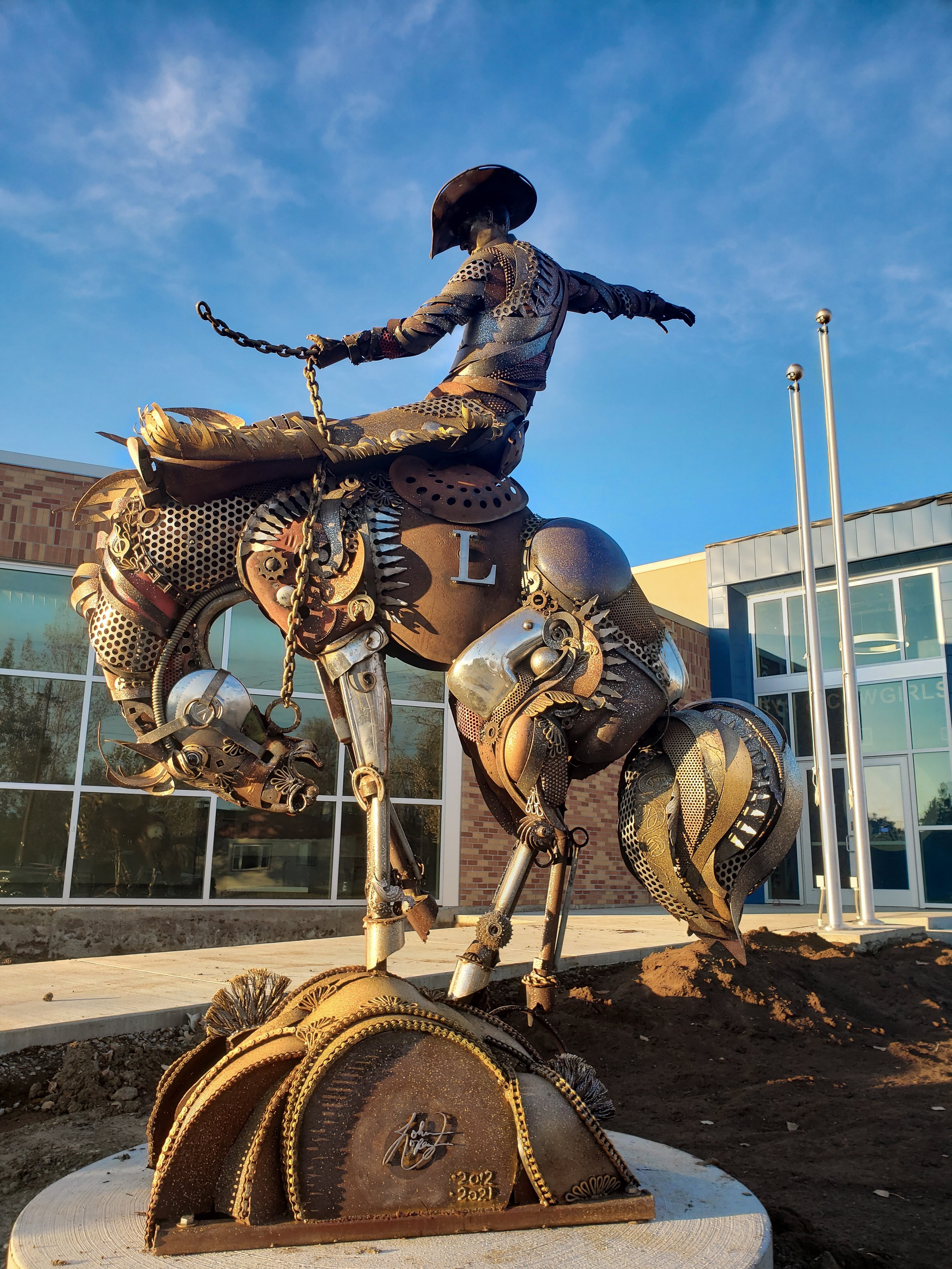
At some point you have to go big or go home. I decided it was time to borrow dimensions from Uncle Geno’s stallion named Frenchman’s Mr. Tough, and then I stared at the scrap pile, visually searching for the graceful curves of a flowing mane and tail. I grabbed the wire-feed welder, acetylene torch, and plasma cutter, then shaped slices of long, curving strips of sheet metal. Then, I welded on hand tools, shovels, chains, files, barbed wire, five western-themed bronze castings, and even truck shocks to form the forearms, gaskins, and cannons of the horse’s legs.
These many hidden elements are tucked throughout the piece; I even included the small model I used to perfect the proportions, welding it into Iron Star’s chest. As the piece came together, every once in a while Geno would recognize one of his former tools. People like to joke that they have to keep the good wrenches away from me. But, I never use anything they could still use. Honest. I really don’t.
The collection of materials in this life-sized horse created an obvious stir in Hill City, South Dakota, after the local arts council purchased the sculpture for the town. Passersby still stop to identify the farm and ranch implements that, from a distance, give the impression of a beautifully conformed horse. The impression is so strong that cowboys who drive by pulling horse trailers have reported that their horses actually whinny when they pass Iron Star!
Haughty, and regal, and loud, the family’s peacocks made a lifelong impression on me. Throughout my youth, I had watched them strut across the yard, their impossibly long tails flowing like water, sparkling in the light, rippling like the train of a wedding dress. When I get inspired to tackle a subject, there are days when I see something and I just have to build it, and there came a day when I had to build a peacock. As I considered the singular tail—decorated with eye-shaped spots—the obvious answer was a pile of flatware connected with steel cable.
It would take 142 forks, 70 spoons, and 71 butter knives to net another People’s Choice Award at the annual Sculpture in the Hills show in Hill City, South Dakota. Since its debut, this piece has been one of the most-talked-about in the Hybrid series.
John has sculpted 12 life-size presidential monuments for The City of Presidents project in Rapid City, SD. Some of the presidents include John F. Kennedy and John Jr., Grant, Carter, Harrison, Coolidge, T. Roosevelt, and Garfield.
This life-size sculpture pays homage to the Northern White Rhino, one of the most-endangered species on the planet. The monument is in a private collection in Florida.